ccsi
Corrected Cardiac Sympathetic Index
| Aliases | corrected_cardiac_sympathetic_index, corrected_csi, modified_csi, csi_mod |
| Domain | geometric |
| Distribution family | LogNormal |
| Equation | 4 * SD2^2 / SD1 |
| Resource intensity | ◍◍◌◌◌ low, Geometric subgraph (Poincaré coords / RR histogram + reductions). Warm (shared representation cached) is 9× cheaper. (measured, see §Resources) |
Definition
Corrected cardiac sympathetic index. Formally: 4 * SD2^2 / SD1.
What does normal look like?
Fitted normative prior: LogNormal(μ = 6.637, σ = 0.8815), KS p = 3.8e-05, n = 61715.
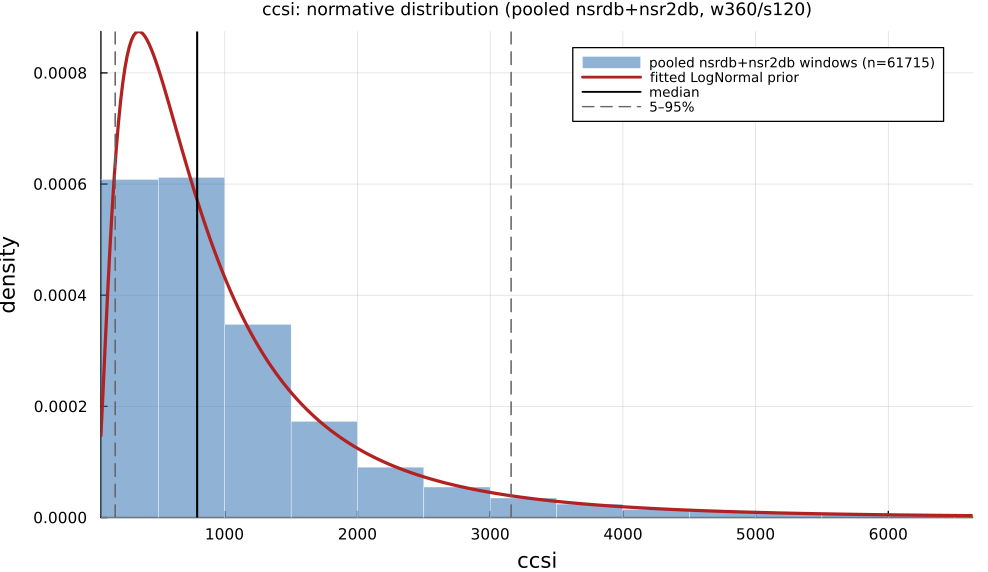
Empirical distribution over the pooled nsrdb+nsr2db normative windows (360-beat windows, 120-beat stride), overlaid with the fitted LogNormal prior density. Vertical lines mark the median and the 5–95% range.
Normal-range summary (pooled nsrdb+nsr2db)
| statistic | value |
|---|---|
| median | 791.8 |
| IQR (25–75%) | 427.3 – 1376 |
| 5–95% range | 174.1 – 3158 |
| mean ± sd | 1108 ± 1114 |
| n windows | 61715 |
n varies by feature only through per-window validity over the full pooled nsrdb+nsr2db table (n up to 61 715; e.g. sampen/mse drop windows where the statistic is undefined). ulf is the one exception: a 360-beat (~5 min) window contains no ULF-band power, so it uses a long-window NSRDB-only extraction (see its own page).
Use cases
- Modified cardiac sympathetic index (4·SD2²/SD1) emphasising long-term spread.
- Lorenz-plot seizure detection (Jeppesen et al. 2014).
- Exploratory autonomic-surge screening (no dedicated validation study on file beyond the seizure-detection setting above; use cautiously).
Applications by area
Evidence is reported at the measure-family level; a specific variant may not be the exact index measured in every cited study.
Clinical
Coverage: individual papers. A small, scattered literature with no pooled meta-analysis.
CSI/CVI (Toichi 1997) separates sympathetic/parasympathetic contributions from a single short ECG without pharmacological blockade; reported clinical uses include psychiatric autonomic dysfunction (CVI drops with worsening psychosis) and epilepsy (CSI spikes distinguish epileptic from psychogenic non-epileptic seizures, though the companion CVI measure does not discriminate the same comparison).
Dominant reported direction: CSI up / CVI down under acute stress or pathology; the two halves of the index do not always agree.
Key references: (Toichi et al., 1997); (Jeppesen et al., 2014); (Jeppesen et al., 2016).
Sports & peak performance
Coverage: individual papers. A small, scattered literature with no pooled meta-analysis.
The one on-topic study (elite football) found CVI differs significantly by playing position but not between athletes and non-athlete controls as a whole: a weaker, more qualified version of the classic "athletes have higher vagal tone" story than the RMSSD-based literature tells; otherwise CSI/CVI appear mainly in methodological papers illustrating exercise/postural-change tracking.
Dominant reported direction: position-dependent; no clear athlete-vs.-control effect at the whole-group level.
Key references: (Toichi et al., 1997).
Contemplative practice
Coverage: sparse or none. Essentially no dedicated application literature found.
No study computes CSI/CVI exactly as Toichi (1997) defined them in a meditation/mindfulness/yoga-breathing population; the same Poincaré-geometry construct appears in meditation studies under other names (SD1/SD2 ratio, ad hoc indices), so the literal CSI/CVI label is essentially absent from this domain even though the underlying geometry is well studied.
Dominant reported direction: no data harvested under this name.
Key references: (Toichi et al., 1997).
See the effect-distribution meta-analysis page for the harvested per-study effect sizes/p-values behind these domain summaries (docs/zoo_gen/effect_stats.csv).
Resources
Resource-intensity rank ◍◍◌◌◌ low is measured: median wall-clock time and allocations over a 360-beat window on synthetic realistic RR (docs/zoo_gen/bench_resources.jl; full grid in resource_bench.csv).
| metric (360-beat window) | value |
|---|---|
| cold median wall-time | 0.0358 ms |
| warm median wall-time | 0.004068 ms |
| allocations (cold) | 32.9 KiB |
Cold = fresh memoization caches (builds every shared representation from scratch); warm = shared representations (diff, periodogram, Poincaré coords, DFA fluctuation) already cached, so only this feature is recomputed. The tier is derived from the cold cost; see Geometric subgraph (Poincaré coords / RR histogram + reductions). Warm (shared representation cached) is 9× cheaper.
Citation
Modified / corrected CSI = 4·SD2²/SD1, Jeppesen et al. (2014), Lorenz-plot seizure detection.
Seminal reference(s): (Jeppesen et al., 2014).
See the References page for the full bibliography.