sdnn
Standard Deviation Of Nn Intervals
| Aliases | std |
| Domain | time, statistics |
| Distribution family | Gamma |
| Equation | std(IBI) |
| Resource intensity | ◍◌◌◌◌ very low, Level 1–2 (base statistics over successive differences). (measured, see §Resources) |
Definition
Standard deviation of NN intervals. Formally: std(IBI).
What does normal look like?
Fitted normative prior: Gamma(α = 3.795, θ = 14.03), KS p = 3.6e-29, n = 61715.
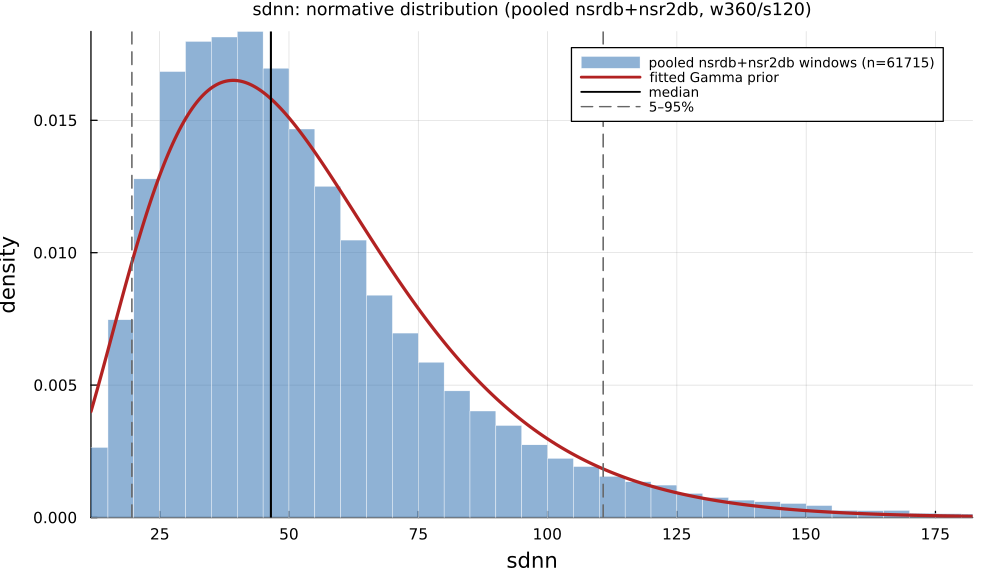
Empirical distribution over the pooled nsrdb+nsr2db normative windows (360-beat windows, 120-beat stride), overlaid with the fitted Gamma prior density. Vertical lines mark the median and the 5–95% range.
Normal-range summary (pooled nsrdb+nsr2db)
| statistic | value |
|---|---|
| median | 46.51 |
| IQR (25–75%) | 32.78 – 65.36 |
| 5–95% range | 19.63 – 110.8 |
| mean ± sd | 53.25 ± 30.13 |
| n windows | 61715 |
n varies by feature only through per-window validity over the full pooled nsrdb+nsr2db table (n up to 61 715; e.g. sampen/mse drop windows where the statistic is undefined). ulf is the one exception: a 360-beat (~5 min) window contains no ULF-band power, so it uses a long-window NSRDB-only extraction (see its own page).
Use cases
- Overall HRV magnitude; prognostic index after myocardial infarction (Kleiger et al. 1987).
- Standard summary of a 24-h or 5-min recording.
- Global autonomic-variability screening.
Applications by area
Evidence is reported at the measure-family level; a specific variant may not be the exact index measured in every cited study.
Clinical
Coverage: statistics. A pooled literature; reviews or meta-analyses exist.
SDNN/SDANN are among the most validated HRV mortality predictors: low values predict higher cardiac/all-cause mortality post-MI, in heart failure, and even in the general population (8 cohorts, n = 21,988). CVNNI has its own well-established sub-literature as a diabetic cardiac autonomic neuropathy screening marker. One acute-decompensated-HF study reports the opposite polarity (higher SDNN/SDANN in the poor-prognosis group).
Dominant reported direction: down: low SDNN/SDANN/CVNNI → higher mortality (one acute-HF exception reversed).
Key references: (Hillebrand et al., 2013); (Rueda-Ochoa et al., 2024).
Sports & peak performance
Coverage: individual papers. A small, scattered literature with no pooled meta-analysis.
Comparatively under-used next to RMSSD in sports HRV monitoring: the field's dedicated meta-analysis pools RMSSD/HF/SD1, not SDNN. Individual studies find SDNN falls with heavy training/overreaching and recovers during taper, and tends to be higher in higher-level athletes, but effect sizes are small-sample and heterogeneous.
Dominant reported direction: down with overreaching, recovers with taper (RMSSD-dominated literature, SDNN secondary).
Key references: (Bellenger et al., 2016).
Contemplative practice
Coverage: individual papers. A small, scattered literature with no pooled meta-analysis.
The weakest of the three domains for this family: two dedicated meta-analyses found the evidence for resting and vagally-mediated HRV (including SDNN) inconclusive or null, with only a handful of trials reporting SDNN at all. Individual acute-state studies diverge sharply in direction (SDNN falls during Heartfulness meditation, rises during Chi/Kundalini-yoga).
Dominant reported direction: contested: meta-analytic null vs. technique-dependent individual-study increases/decreases.
Key references: (Rådmark et al., 2019); (Brown et al., 2021).
Meditation's effect on SDNN is disputed: one study found SDRR decreased during Heartfulness meditation, while another found it increased during Chi/Kundalini-yoga meditation; both are small, single-technique studies ((Natarajan, 2023); (Rådmark et al., 2019) for the pooled mindfulness-HRV review these sit alongside).
See the effect-distribution meta-analysis page for the harvested per-study effect sizes/p-values behind these domain summaries (docs/zoo_gen/effect_stats.csv).
Resources
Resource-intensity rank ◍◌◌◌◌ very low is measured: median wall-clock time and allocations over a 360-beat window on synthetic realistic RR (docs/zoo_gen/bench_resources.jl; full grid in resource_bench.csv).
| metric (360-beat window) | value |
|---|---|
| cold median wall-time | 0.002885 ms |
| warm median wall-time | 0.002765 ms |
| allocations (cold) | 736 B |
Cold = fresh memoization caches (builds every shared representation from scratch); warm = shared representations (diff, periodogram, Poincaré coords, DFA fluctuation) already cached, so only this feature is recomputed. The tier is derived from the cold cost; see Level 1–2 (base statistics over successive differences).
Citation
Kleiger et al. (1987) established SDNN as the prognostic 24-h HRV index and popularised it; standardised by the Task Force (1996). Primacy contested: Wolf et al. (1978) had already linked a cruder RR-interval SD/variance measure to lower post-MI hospital mortality nearly a decade earlier.
Seminal reference(s): (Kleiger et al., 1987); (Wolf et al., 1978); (Task Force, European Society of Cardiology / North American Society of Pacing & Electrophysiology, 1996).
See the References page for the full bibliography.