tinn
Triangular Interpolation Of Nn Interval Histogram
| Aliases | triangular_interpolation_of_nn_intervals |
| Domain | geometric |
| Distribution family | Gamma |
| Equation | M - N (triangle base width) |
| Resource intensity | ◍◍◍◍◍ very high, Geometric subgraph (Poincaré coords / RR histogram + reductions). (measured, see §Resources) |
Definition
Triangular interpolation of NN interval histogram. Formally: M - N (triangle base width).
What does normal look like?
Fitted normative prior: Gamma(α = 5.321, θ = 30.91), KS p = 1.8e-18, n = 61715.
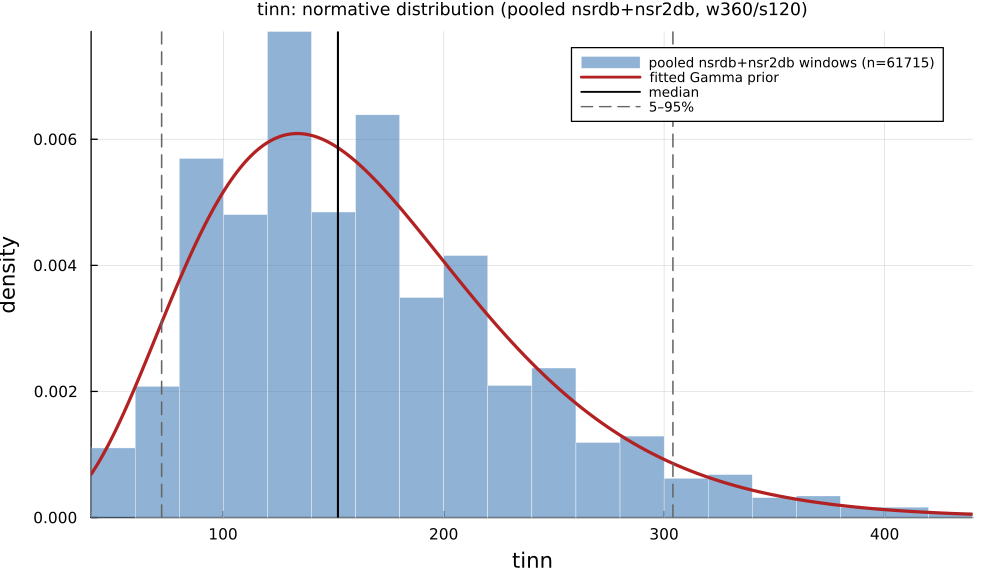
Empirical distribution over the pooled nsrdb+nsr2db normative windows (360-beat windows, 120-beat stride), overlaid with the fitted Gamma prior density. Vertical lines mark the median and the 5–95% range.
Normal-range summary (pooled nsrdb+nsr2db)
| statistic | value |
|---|---|
| median | 152 |
| IQR (25–75%) | 112 – 200 |
| 5–95% range | 72 – 304 |
| mean ± sd | 164.5 ± 73.8 |
| n windows | 61715 |
n varies by feature only through per-window validity over the full pooled nsrdb+nsr2db table (n up to 61 715; e.g. sampen/mse drop windows where the statistic is undefined). ulf is the one exception: a 360-beat (~5 min) window contains no ULF-band power, so it uses a long-window NSRDB-only extraction (see its own page).
Use cases
- Baseline width of the triangular RR-histogram interpolation.
- Geometric variability summary robust to outliers.
- Companion to the triangular index.
Applications by area
Evidence is reported at the measure-family level; a specific variant may not be the exact index measured in every cited study.
Clinical
Coverage: statistics. A pooled literature; reviews or meta-analyses exist.
HTI (and TINN) are original 1996 Task Force geometric measures that remain recurring prognostic markers: reduced HTI/TINN is associated with higher post-MI and atrial-fibrillation mortality and reduced diabetic autonomic integrity: except one hemodialysis-AF cohort reporting a U-shaped, not monotonic, relationship.
Dominant reported direction: down: lower HTI/TINN → worse outcome (one U-shaped exception).
Key references: (Task Force, European Society of Cardiology / North American Society of Pacing & Electrophysiology, 1996); (Stuckey et al., 2014).
Sports & peak performance
Coverage: individual papers. A small, scattered literature with no pooled meta-analysis.
Not the sports-science metric of choice: a 138-athlete profiling study and dedicated exercise-HRV meta-analyses bypass HTI/TINN entirely in favor of SDNN/RMSSD/LF-HF. Where it is reported, HTI rises with higher aerobic/endurance training status.
Dominant reported direction: up with endurance training status (rarely reported).
Key references: (Stuckey et al., 2014).
Contemplative practice
Coverage: sparse or none. Essentially no dedicated application literature found.
Six targeted searches of the most relevant meditation/mindfulness HRV papers found none reporting HTI or TINN: these studies uniformly use SDNN/RMSSD/LF-HF instead, plausibly because typical meditation-session recordings (5–20 min) are too short for a stable NN-interval histogram (the Task Force recommends ≥20 min, ideally 24 h).
Dominant reported direction: no data harvested for this domain.
Key references: (Task Force, European Society of Cardiology / North American Society of Pacing & Electrophysiology, 1996).
See the effect-distribution meta-analysis page for the harvested per-study effect sizes/p-values behind these domain summaries (docs/zoo_gen/effect_stats.csv).
Resources
Resource-intensity rank ◍◍◍◍◍ very high is measured: median wall-clock time and allocations over a 360-beat window on synthetic realistic RR (docs/zoo_gen/bench_resources.jl; full grid in resource_bench.csv).
| metric (360-beat window) | value |
|---|---|
| cold median wall-time | 56.3 ms |
| warm median wall-time | 55.28 ms |
| allocations (cold) | 51.3 MiB |
Cold = fresh memoization caches (builds every shared representation from scratch); warm = shared representations (diff, periodogram, Poincaré coords, DFA fluctuation) already cached, so only this feature is recomputed. The tier is derived from the cold cost; see Geometric subgraph (Poincaré coords / RR histogram + reductions).
Citation
Triangular Interpolation of the NN histogram (TINN), Malik et al. (1989) / Task Force (1996).
Seminal reference(s): (Malik et al., 1989); (Task Force, European Society of Cardiology / North American Society of Pacing & Electrophysiology, 1996).
See the References page for the full bibliography.